Proof of consent
Proof of consent under GDPR Article 7: what a record should contain
On this page
The short answer
If you process data on the basis of consent, Art. 7(1) GDPR requires you to be able to show that the person consented. A configured banner on your website does not show that. A record for each decision does.
That record holds five things: when the decision was made, which version of the banner was live, the text the visitor saw in that version, what the visitor chose, and an ID that links the record to the device without naming the person. The GDPR sets no fixed retention period. You keep the record while you rely on the consent and for as long afterwards as you may need to defend a claim.
The obligation: Art. 7(1) and Art. 5(2) GDPR
Two provisions put the burden of proof on the controller. Art. 5(2) GDPR is the accountability principle. The controller is responsible for the principles in Art. 5(1) and must be able to demonstrate compliance with them. Art. 7(1) applies this to consent. Where processing is based on consent, the controller must be able to demonstrate that the data subject consented to the processing of their personal data.
Cookie consent falls under the same rule. Art. 5(3) of the ePrivacy Directive requires consent for storing and reading information on a device, and Art. 2(f) of that directive takes the definition of consent from EU data protection law, which is now the GDPR. In Germany, § 25(1) TDDDG states directly that information and consent follow Regulation (EU) 2016/679.
The European Data Protection Board explains what this means in practice in its Guidelines 05/2020 on consent, paragraphs 104 to 108. The GDPR does not prescribe a method. The controller must still be able to prove that a data subject consented in a given case. For an online context, the EDPB suggests keeping information on the session in which consent was given, documentation of the consent workflow at that time and a copy of the information shown. Paragraph 108 ends with this sentence: "It would not be sufficient to merely refer to a correct configuration of the respective website."
What a record contains
The EDPB also warns against the opposite mistake. The duty to demonstrate consent should not lead to excessive additional processing, and Art. 5(1)(c) GDPR requires data minimisation. A record needs enough data to link a decision to the processing, and no more. Five fields cover that.
- Timestamp. The time of the decision, set by your server in UTC, so a wrong clock on the visitor's device cannot shift it.
- Banner version. A version number or identifier of the configuration that was live, so you can tell which purposes, categories and vendors the visitor was asked about.
- The text shown. The wording of the banner and of the detail layer in the visitor's language, or a reference to it that cannot be changed later without notice. The next section explains why consent cannot be proven without this field.
- The choice. Accept all, reject all or a custom selection with the state of each category. Withdrawals belong in the same log, because Art. 7(3) GDPR lets the visitor withdraw at any time.
- A pseudonymous ID. A random value stored in the consent cookie that ties later records from the same device together. It contains no name or email address. Art. 4(5) GDPR defines pseudonymisation as processing after which data can be attributed to a person only with additional information kept separately.
Fields that help match a complaint
Some fields make a record easier to match with a complaint without identifying anyone. The page path and origin show on which site and page the decision happened. The banner language shows which translation applied. The browser's user agent helps when a person disputes a decision made on a specific device. A shortened IP address shows the network region without the full address.
Leave out what you do not need. A full IP address, an email address or a customer number in the consent log turns a pseudonymous record into a directly identifying one, and Art. 5(1)(c) GDPR asks you to justify every field.
Why the text shown counts: Orange România
Consent is valid only if it is informed. Art. 4(11) GDPR requires an informed and unambiguous indication of wishes, given by a statement or a clear affirmative action. Whether a visitor was informed depends on what they read, so the text is part of the proof.
The Court of Justice made this concrete in Orange România (C-61/19) on 11 November 2020. A mobile operator kept copies of customers' identity cards and relied on a contract clause saying the customers had been informed and had consented. The box next to the clause had been ticked by sales staff before the customers signed. The Court ruled that it is for the controller to demonstrate that the data subject gave consent by active behaviour and received information on all the circumstances of the processing beforehand, in an intelligible and easily accessible form, using clear and plain language.
For the contract in that case, the Court named three situations in which the clause does not prove valid consent: the controller ticked the box before signing, the terms could mislead the customer into thinking a contract was not possible without consent, or refusing required filling in an extra form. On a cookie banner the parallels are pre-selected categories, a reject option that is harder to reach than accept, and texts that hide what happens after a refusal.
A year earlier, in Planet49 (C-673/17) of 1 October 2019, the Court had already ruled for cookies that a pre-ticked checkbox that the user has to untick is not valid consent. The information given must also include how long cookies stay active and whether third parties can access them. If your record does not show which text and which defaults the visitor saw, you cannot show that the consent met these conditions.
Tamper evidence with a hash
A hash function turns any input into a fixed-length value. SHA-256 produces 256 bits, written as 64 hexadecimal characters. The same input always gives the same value, and changing a single character of the input gives a different one. The function cannot be run backwards to recover the input.
For consent records this has two uses. A hash over the banner text and vendor list identifies the exact wording a visitor saw. Anyone holding that text can compute the hash again and compare it with the value in the record. A hash over the record fields shows whether a stored record still matches what was written at the time of the decision.
A hash detects a change. It does not prevent one. Someone with write access to both the record and its hash can change both, so the hash is as good as the access controls around it. Art. 32(1)(b) GDPR lists the ability to ensure the ongoing integrity of processing systems among the appropriate measures. Restricting who can write to the consent log is one such measure.
How Limes stores a record
In Limes the browser creates a random consent ID, shown as Proof ID in the app, and stores it in the consent cookie. For each decision the Limes server writes a record with the UTC timestamp, the action, the selection per category, the Google Consent Mode v2 state, the banner version, the SHA-256 hash of the banner text and vendor list, the country, the user agent, the page and the banner language. IPv4 addresses are shortened to /24 and IPv6 addresses to /48 before storage. A SHA-256 hash over the record fields is stored with the record. Records are stored in Frankfurt. Limes stores the hash of the banner text, not the text itself. Keep a copy of the banner and detail-layer text for each banner version. The consent proofs page explains how a record is sealed.
Retention: the GDPR sets no fixed period
No article of the GDPR names a number of years for consent records. Two principles set the frame. Art. 5(1)(e) GDPR allows storage only as long as necessary for the purpose. The EDPB says in paragraph 107 of its consent guidelines that the obligation to demonstrate consent lasts as long as the processing does, and that afterwards the proof should be kept no longer than strictly necessary to comply with a legal obligation or to establish, exercise or defend legal claims, with reference to Art. 17(3)(b) and (e) GDPR.
In practice the period is the life of the consent plus the time in which someone can bring a claim or an authority can open a case. Limitation periods come from national law. In Germany the regular limitation period for civil claims is three years under § 195 BGB, and under § 199(1) BGB it starts at the end of the year in which the claim arose and the claimant learned of the claim and of the debtor, or would have learned of them without gross negligence. Sector rules can add their own periods. The controller sets the period, with advice from the data protection officer if there is one, and records it in the record of processing activities under Art. 30 GDPR.
Limes keeps records for a fixed period per plan, so you can choose the plan that covers the period you set.
Proof retention per Limes plan
| Plan | Retention of consent records |
|---|---|
| Free | 1 year |
| Starter | 3 years |
| Professional | 3 years |
| Business | 6 years |
| Agency | 10 years |
| Proof Vault add-on, Professional and Business | 10 years |
Exporting records for an authority or a court
Under Art. 58(1)(a) GDPR a supervisory authority can order you to provide any information it needs for its tasks. In a civil dispute, the burden of proof from Art. 7(1) GDPR means you bring the evidence. In both cases you need two views of the log: the history of one consent ID, and all decisions of a period.
- Find the consent ID. The person can read it from the consent cookie in their browser, or you find it through the time and page of the disputed visit.
- Pull every record for that ID in order: the first decision, later changes and a withdrawal, if there was one.
- Match the banner version in each record to the text that was live at that time, and keep that text with the export.
- Export the period in question as a file that the other side can open without your software, for example CSV.
- Document who made the export and when, so the chain from the log to the file is traceable.
Exporting in Limes
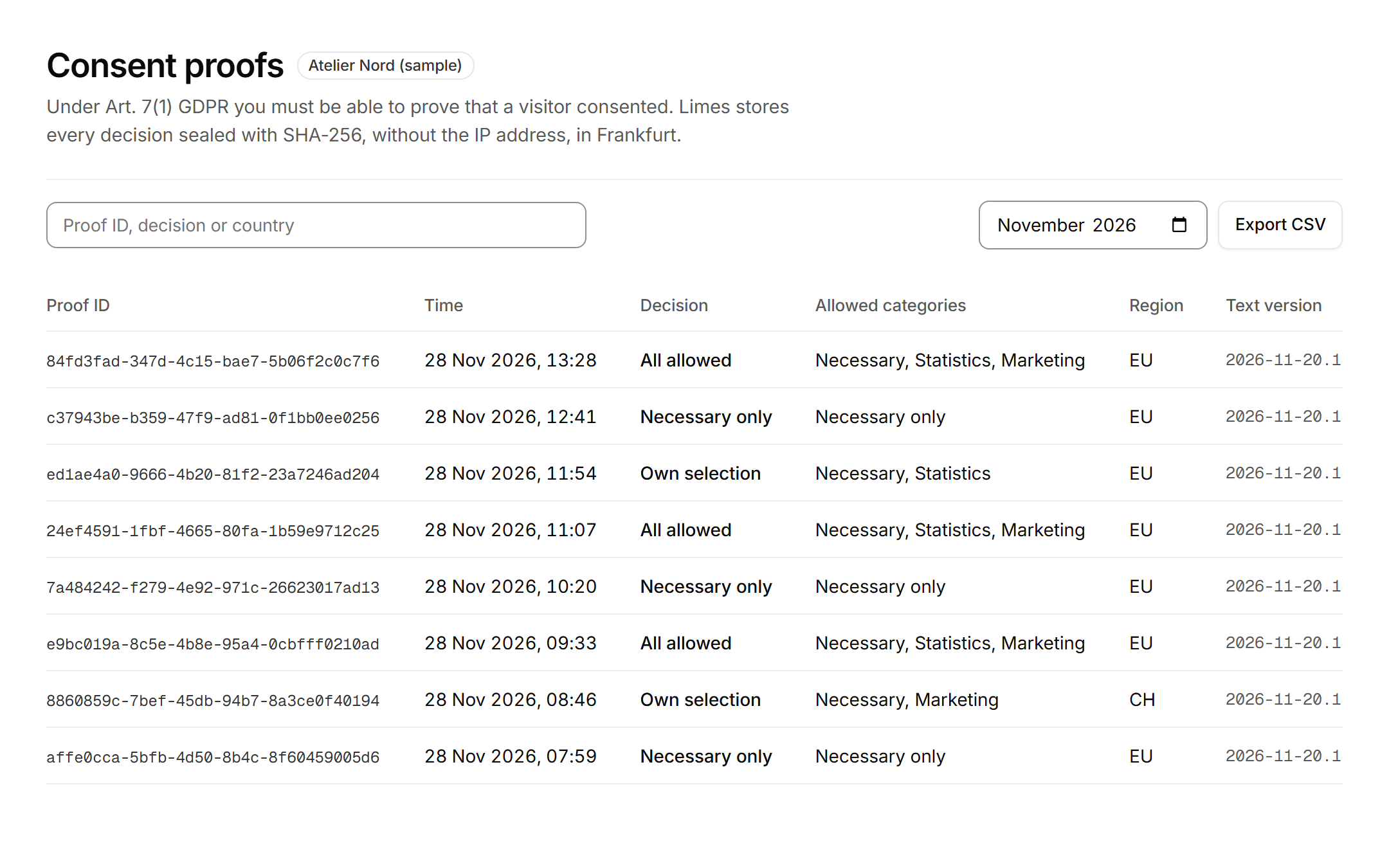
On the Proofs page of the Limes app you search for a Proof ID and see every decision stored for it. From the Starter plan you download the records of a month as a CSV file with Proof ID, time in UTC, decision, selection, banner version and region. The file uses semicolons and starts with a UTF-8 byte-order mark. Excel opens it in columns with umlauts intact where the regional list separator is a semicolon, as in German or French settings.
If you need more than 3 years of retention or more than 3 domains, look at the Business plan. It keeps records for 6 years, covers 10 domains and scans each site daily, from €89 per month on annual billing. Pricing compares the plans, and consent proof for regulated firms shows the setup for law offices, practices and advisers. The legal background of consent is on GDPR cookie consent.
Frequently asked questions
What is proof of consent under the GDPR?
It is the evidence that a specific person consented to a specific processing. Art. 7(1) GDPR requires the controller to be able to produce it. For a cookie banner it is a record per decision with the time, the banner version, the text shown or its hash, the choice and a pseudonymous ID.
How long do I have to keep proof of consent?
The GDPR sets no number of years. The EDPB says you keep proof while the processing lasts and afterwards only as long as strictly necessary for a legal obligation or for legal claims. The controller sets the period, with advice from the data protection officer if there is one, often based on national limitation periods.
Do I need to store the full IP address as proof?
No. The GDPR does not require it, and Art. 5(1)(c) GDPR asks for data minimisation. A random consent ID links the records of one device. A shortened IP address is enough to show the network region.
Is a screenshot of my banner enough proof?
No. The EDPB says it is not sufficient to merely refer to a correct configuration of the website. A screenshot shows the configuration, not the decision of one person. You need a record per decision that points to the text shown at that time.
Sources
- Regulation (EU) 2016/679 (General Data Protection Regulation)(opens in a new tab) Art. 4(5), Art. 4(11), Art. 5(1)(c) and (e), Art. 5(2), Art. 7(1) and (3), Art. 17(3), Art. 30(1)(f), Art. 32(1)(b), Art. 58(1)(a) and recital 26.
- Guidelines 05/2020 on consent under Regulation 2016/679, version 1.1(opens in a new tab) Adopted 4 May 2020, version 1.1 of 13 May 2020. Section 5.1, paragraphs 104 to 108, on demonstrating consent.
- Orange România, C-61/19(opens in a new tab)
- Planet49, C-673/17(opens in a new tab)
- Directive 2002/58/EC (ePrivacy Directive)(opens in a new tab) Art. 2(f) and Art. 5(3).
- § 25 TDDDG, protection of privacy in terminal equipment(opens in a new tab)
- § 195 BGB, regular limitation period(opens in a new tab)
- § 199 BGB, start of the regular limitation period(opens in a new tab)