Comparison
Limes or Usercentrics? Consent rate, price and proof compared
Short answer
Limes shows your consent rate on every plan and tests two banner variants from Professional. Usercentrics is a full-featured consent management platform aimed at companies of every size, including large enterprises. Limes focuses on a narrower job: a fast, balanced cookie banner with Google Consent Mode v2, consent proofs hosted in Frankfurt and plans billed on sessions and domains. If you mainly need web consent for a handful of sites or for client websites, Limes is designed to be simpler to set up and to budget.
- Consent rate and A/B tests
- Rate on every plan, A/B tests from Professional
- Proof storage
- Frankfurt (eu-central-1)
- Pricing basis
- Sessions + domains
- Free plan
- 1 domain, 2,500 sessions/mo
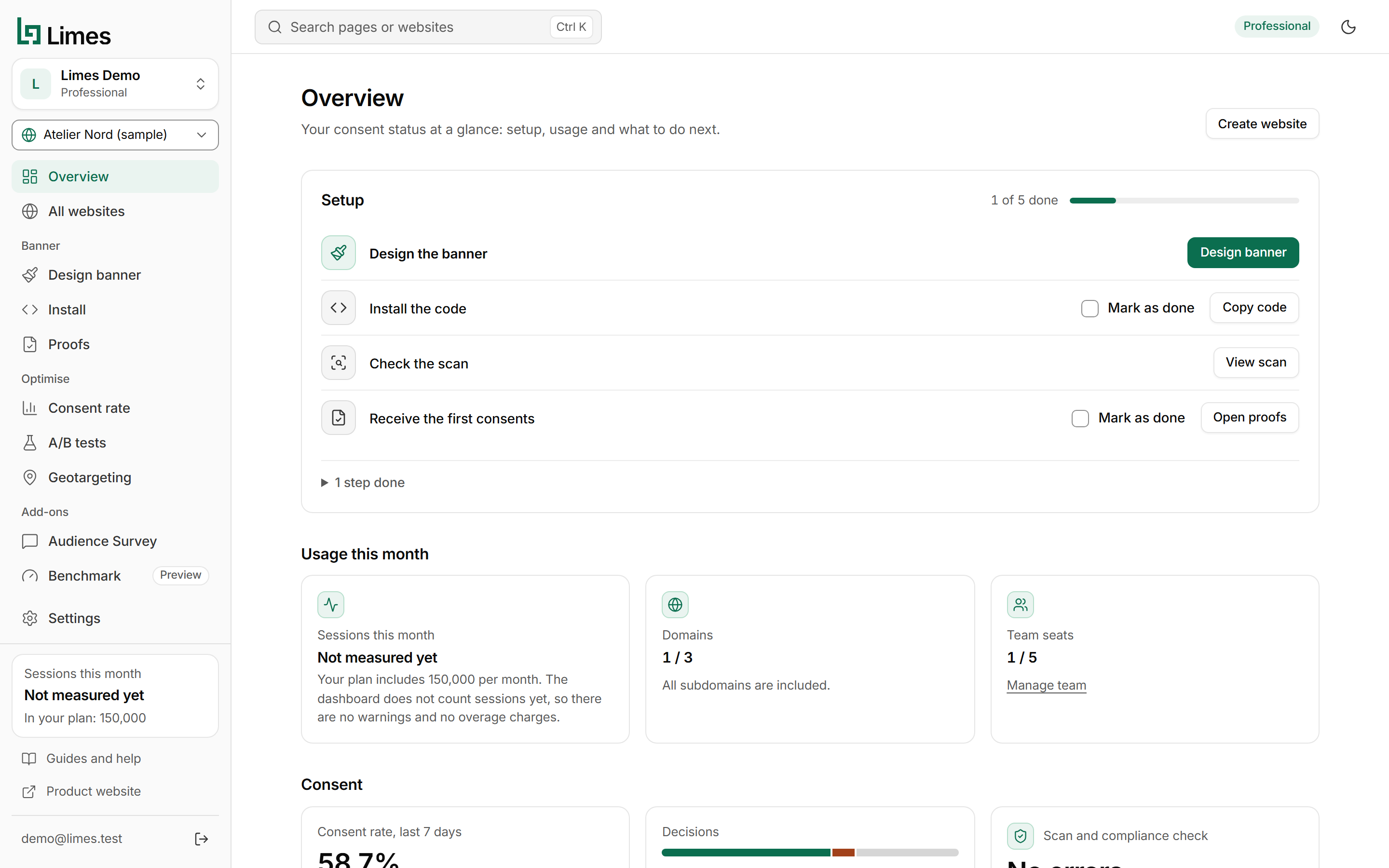
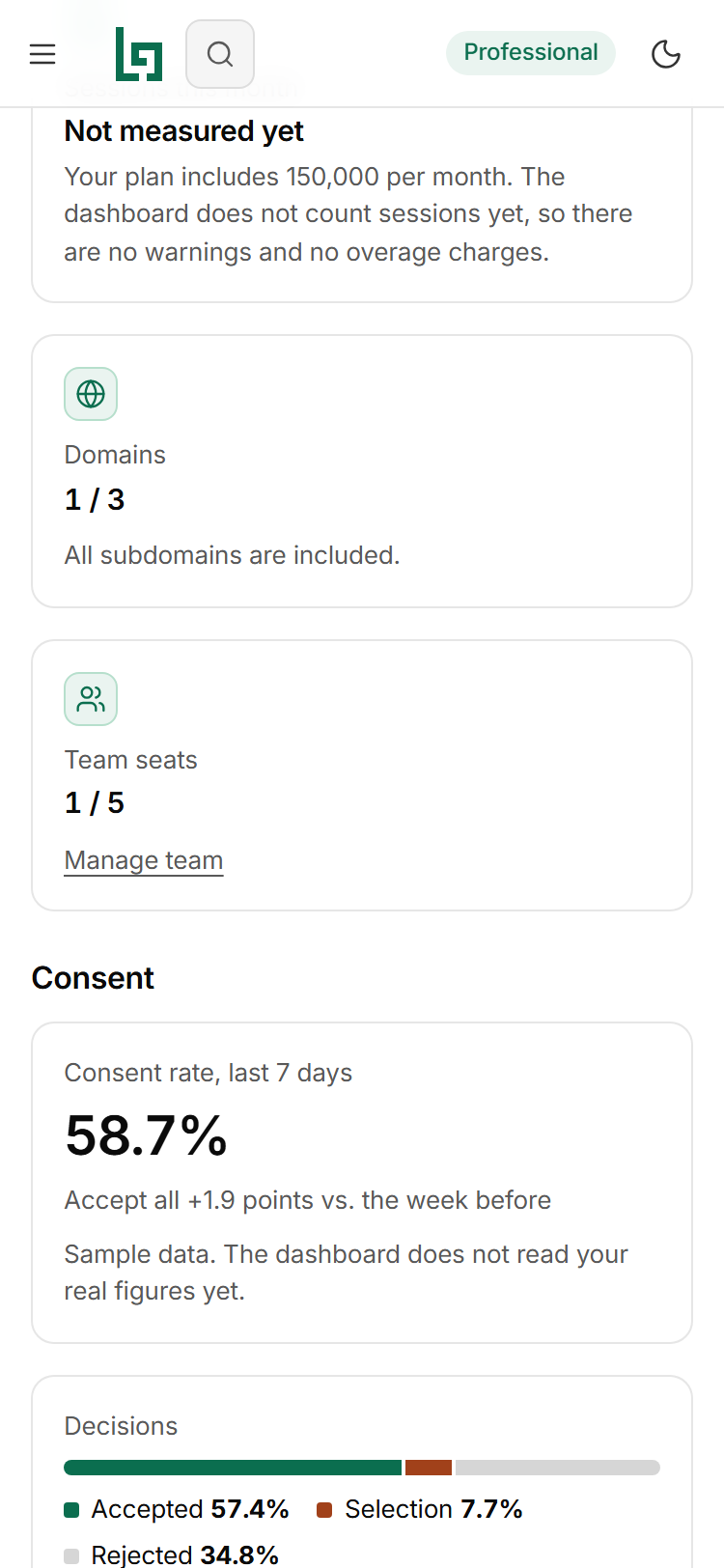
Usercentrics and Limes at a glance
Usercentrics offers web and app consent, a large template database and enterprise features. The comparison below covers web consent only and is limited to points you can check yourself.
| Criterion | Limes | Usercentrics |
|---|---|---|
| Scope | Web consent for websites and shops | Web and in-app consent, enterprise features |
| Consent rate and A/B tests | Overall rate on every plan, breakdown and A/B tests from Professional | Check the feature list |
| Pricing basis | Monthly sessions + domains, one pooled allowance. Free: 1 domain, 2,500 sessions | Tiered plans; check the current metrics (e.g. sessions, domains) and limits on the vendor's pricing page |
| Consent data hosting | Proofs and workspace data in Frankfurt (EU), script through Amazon CloudFront | Check the data processing agreement and subprocessor list |
| Consent proofs | SHA-256 sealed, kept 1 to 10 years depending on the plan, CSV export from Starter | Consent log; check retention and export per plan |
| Banner design rules | Accept and Reject at equal size, contrast checked before every publish | Configurable; balance depends on your configuration |
| Google Consent Mode v2 | Every plan. Google Tag Manager loads after consent by default | Supported |
| IAB TCF | IAB TCF 2.2 (beta) from Professional. No TC string, vendor list or registered CMP ID yet | Supported |
| Agencies | Agency plan: 50 domains and 2,500,000 sessions in one pool. Client workspaces and white label follow | Partner programme; check current terms |
Plans you can explain to a finance team
Limes has five plans. Each higher plan adds limits and features for one use case: Starter adds your own branding, Professional adds consent-rate tools, Business adds governance and Agency adds client management.
- Starter: €12/month: 1 domain, 25,000 sessions, no Limes badge, custom CSS, proof export.
- Professional: €39/month or €29/month billed annually: 3 domains, 150,000 sessions, A/B testing, consent analytics, geotargeting, TCF API (beta).
- Business: €119 a month for 10 domains and 750,000 sessions, with audit log and daily scans.
- Agency: €299 a month for 50 domains and 2,500,000 sessions, with an SLA on request. Client workspaces and white label follow.
All prices in EUR excluding VAT. Annual billing saves 20% to 25%, depending on the plan.
Hosting and proof of consent
Whichever tool you choose, you must be able to demonstrate consent (Art. 7(1) GDPR). Limes records each decision with timestamp, banner version and choice, seals each record with SHA-256 and stores the proofs in Frankfurt.
Balanced banners are enforced
Limes does not publish a banner where Reject is harder to find than Accept, where contrast falls below WCAG AA or where optional categories are pre-ticked. European data protection authorities expect a balanced first layer, so Limes enforces it.
How to switch from Usercentrics to Limes
Plan the switch as one deployment so that visitors never see two banners at once.
-
Scan your site
Run a Limes scan of your live site to inventory every script and cookie that is currently set.
-
Build the banner
Create your banner in the Limes editor, add the services you actually use and publish once the built-in compliance check is green.
-
Remove Usercentrics
Remove the Usercentrics loader script (and any data-usercentrics script attributes or tag manager templates) from your site.
-
Add the Limes script
Add the Limes script as the first script in the <head>, above Google Tag Manager, GA4 or ad pixels.
-
Point Tag Manager at Limes
If you use Google Tag Manager, point your triggers at the Limes event cookie_consent_update. Limes loads the container only after consent by default.
-
Test in a private window
Test in a private window: no analytics or marketing cookies before a choice, the reject button works, and the footer link reopens the settings.
Consents collected by Usercentrics cannot be carried over: they belong to a different banner text and vendor list, so visitors are asked once more. Export your old consent log and keep it for as long as you need to be able to demonstrate past consent.
When Usercentrics may be the better fit
If you need consent for mobile apps and websites from one platform, enterprise procurement features, or you monetise through Google's publisher products and need a Google-certified TCF CMP, compare Usercentrics' current offering closely. Limes is deliberately focused on web consent for businesses, shops and agencies.
Frequently asked questions
Is Limes a good Usercentrics alternative for small businesses?
Yes, that is the core audience. You can start on Free (1 domain, 2,500 sessions a month) and move to Starter at €12/month when you want your own branding.
Does Limes support app consent?
No. Limes covers websites and online shops. If you need in-app consent, use a tool built for mobile SDKs.
Where is Limes consent data stored?
Consent records are stored in Frankfurt, Germany (AWS eu-central-1). The banner script and consent requests are delivered through the Amazon CloudFront CDN.
Can agencies manage client sites separately?
Not yet. Client workspaces and white label follow. Today the Agency plan puts 50 domains and 2,500,000 sessions in one workspace, and you invite clients as seats.
Related pages
See how a focused CMP feels
Create a banner, run the compliance check and publish. The Free plan needs no payment details.